Consulting
You adopted coding agents to go faster. At real scale, they made your development lifecycle the bottleneck instead.
Whether the speed never materialized, or it did and now review, testing, and architecture are buckling under the volume — the cause is the same. Your lifecycle was built for human-paced code. Agents don't fix that on their own; it takes new process, structure, and control to convert them into throughput at a 50-developer org. This separates vibe coding prototypes from high-quality professional product development.
It's 80% organization, 20% tools
Most agentic-engineering efforts stall, and they rarely stall on the technology. The agents do their job. What breaks is everything they run into: review processes that drown when output multiplies, quality gates that were never designed for machine-generated code, test management that can't keep pace, security and compliance controls that assume a human authored every line, and team structures and ownership models built for a different way of working.
The tools and agents are essential, but standing them up is maybe a fifth of the work. The other 80% is organizational: a clear strategy, a real change process, guardrails that hold requirements and context to a high standard, and a concrete workflow your teams actually run. Get that wrong and more capable agents simply produce more risk, faster. Building that 80% around your tools is where this consulting lives, and it's where most teams have no one to turn to.
The transformation only works if it works for every role
Agentic engineering reshapes what each person on the team does, and each has a distinct set of problems that tool-led adoption leaves unaddressed. A transformation that ignores any of them fails quietly:
Product Owners
lose their feel for scope and estimation when delivery speed becomes erratic, and struggle to plan when "how long will this take" no longer has a familiar answer.
Software Architects & Lead Developers
watch architectural intent erode as agents generate plausible code that doesn't fit the system, and carry a review burden that scales faster than they can sustain — without clear control points, coherence slips away one merge at a time.
Test Managers
face code volumes that outpace existing test strategy, and the hard question of how to assure quality when a machine wrote the first draft — where coverage, confidence, and meaningful gates have to be redefined, not just turned up.
DevOps & Platform Engineers
absorb more frequent, larger, less predictable changes, and need pipelines, guardrails, and environments that stay safe under that pressure rather than becoming the thing everyone routes around.
Security & Compliance owners
confront a lifecycle where the assumption that a human authored and understood every line no longer holds — and where GDPR and audit obligations need controls rebuilt for machine-speed development.
Naming these isn't decoration. Most efforts fail because they're run as tool rollouts instead of a coordinated change across exactly these roles. We design the transformation around them.
How we typically work
Analyze the current state. Your processes, workflows, team structures, and tooling (Jira, Confluence, GitLab, Kubernetes, and the rest) — and above all the restrictive side of your lifecycle: quality gates, test management, security, GDPR. We capture baseline metrics here (cycle time, review load, lead time, escape rate) so progress is provable, not asserted.
Define the target automation level. What degree of agentic automation your organization can and wants to reach — reconciling executive ambition with engineering reality and the change your teams can actually absorb.
Build the roadmap. A concrete, incremental plan from current state to target, in defined increments and milestones — sequenced so each step delivers value and de-risks the next.
Although we offer solutions for professional agentic coding like architrace, our consulting is tool-agnostic and is only focussed on your success.
Lead the implementation. Hands-on support through the transformation — embedded as deeply as the situation needs, working alongside your teams rather than handing over a slide deck.
It starts with a free intro call to talk through your goals and the issues worth tackling. From there, the recommended first engagement is a fixed-scope Agentic Engineering Assessment: a focused diagnostic of where you are and what's most at risk, with a prioritized roadmap you keep, valuable on its own, whether or not we go further.
The call is free. Everything beyond it is paid work — that's where the real thinking starts.
Who you work with
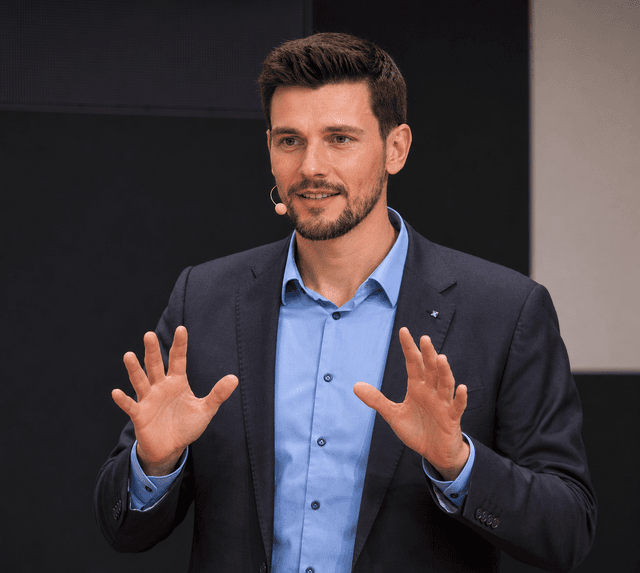
Founder & Experienced Tech Lead
Dr. Florian Patzer
Dr. Florian Patzer is the founder and principal of mode41 — a practitioner with a strong background in agentic engineering, software architecture, and technology strategy, from conception through implementation. He is co-founder and CTO of nodeline GmbH, a former leading scientist at Fraunhofer, and an agentic engineering consultant at Bundesdruckerei. This is experience from doing agentic engineering in production, applying the mode41 methodology — not repackaging it secondhand.
You work directly with a principal who does this in production, applying the mode41 methodology in your context — not an account manager passing you to a junior team.
Ready to talk?
Tell us about your team and where agents are outpacing your process.
Book an intro call